
“If you do what you have always done, you will not go far from the results you have always achieved”

I still remember very clearly a phrase that for years I simply interpreted as “the general’s signature,” and the phrase was “what bad habits you have!”
The general was (and still is) my mother, and the habits were those of a manchild, like many others, very lively and, I would never deny it, very messy and lazy. The phrase was liberally distributed every time I watched her tidy up the mess I incessantly created. I hated it when she tidied up or generally did housework, because “she” stopped playing with me. Aside from that, the rest of the conversation was peppered with not-so-veiled threats to throw practically everything out if I didn’t decide to tidy up. Now, there are those who pay little attention to mess and live fine even with something out of place. Then there are those who, if they take off a shirt, immediately fold it and put it in the wardrobe. I was one of the former, and no shirt ever complained about me.
Mess is freedom. The freedom to feel like you own the freedom to not tidy things up. At a certain point, I thought it was simply a matter of “silently disobeying” that “tidy up your room right now!” A bit like when you grow up and think that growing up means being “automatically” authorized to swear. However, for me, there came a point when I felt uncomfortable looking around me in my daily life, at home or at work.
Ignoring something that was useful to me, all things considered, to feel “falsely free” from the reproach in my head, I thought was freedom.
And it was. But it was an ephemeral sensation. I realized that I felt free, yes, but also a slave to my habitual and unaesthetic mess. That push of mild discomfort was enough to start changing something about myself that I was beginning to label as wrong. So I began working on my small, bad habits, trying to improve small things first—low emotional impact—and then moving on to more serious things, which I recognize would have had a significant impact on many aspects if only I had realized it sooner.
So I began, almost unconsciously, though motivated, to work on the many small habits that perhaps only accounted for a small 1%. Only years later did I discover that there was a whole science behind efficiency gains: “1% efficiency gain.“
Now, getting back to us, Alfa says in his famous song that if you sleep 8 hours a night, you sleep 100 days in a year. Actually, it’s 121, but in the song, 100 is more appropriate. Therefore, if you work 8 hours a day, another 121 days in a year are gone. So, if you include naps, dead hours in front of the TV, phone conversations, Facebook, Instagram, and YouTube, lunch, dinner, and breakfast, and even more hours in the bathroom with social media, we count another 6 hours a day.
If we’re good, we have 40 days in a year to do everything else, which is more or less tidying up the mess, cooking, then tidying up the kitchen and then tidying it up again, and living in other areas of the house. A few hours outside, or with friends, or having dinner out.
It seems absurd, but the small habit of picking up a pair of shoes and immediately putting away another, the one you’re wearing, is a habit that gave me my first sense of freedom from clutter. Before, my excuse was “I have to have things on hand”—that was the idea of freedom in my home. Then I lived the day, or what remained of it, bothered by the thought of seeing things lying around rather than in their proper place. Small steps and small changes to a mechanism that seemed perfectly normal put tiny but unpleasant sensations back into place.
In this regard, several years later, I found the motto on the Brazilian flag to be incredibly impactful: “Ordem e Progresso” (Order and Progress), the story of which I’ll share in the link.
Habits, to the extent of their academic definition, are like little patterns for me. You know when you sleep with your face on the pillow and the marks remain on your face for a few minutes as soon as you wake up?
Well, that’s how I imagine them, with the difference that instead of being a light imprint on the skin, I see them in my imagination as traces carved into a smooth surface, that of our daily being. It’s a visual sensation. For those who remember, it’s like tracks on a vinyl record. And just as a needle retraces the tracks of a vinyl record every time you listen to a song, we retrace the same habits every day on autopilot, accepting them, in exactly the same way.
One day, around age 30, I found myself immersed in a book I was very passionate about, which was about software development. I remember very well that it was summer and a Sunday. For some reason, the author mentions the word “procrastination” about himself without spending some words or much time to explain discussing it. It not was the argument of article. I had never heard the term, so I looked it up. I was thirty in 2005, so no smartphone. It means “get up, grab a dictionary, and look it up.” I read the description and felt an unpleasant sensation, like when you feel caught without excuse dipping a spoon into Nutella at 1 a.m. That little article was talking about me. It was describing procrastination as if it were written, in bold in place of the word it needed explaining: “This is you.!”
Besides remembering that it was summer, a Sunday morning, and a beautiful day, the impulse was to look at the clock, and I remember “10:57” very clearly. I’ve never erased that scene from my mind.
I left the dictionary on the first free shelf, just to say I didn’t put it back. I didn’t finish reading the article, which I had begun comfortably on the couch, and that day, gripped by the bother, I spent remedying all the trace of my procrastination around me. That evening, I felt good because I had removed out most of those marks.
The scars left by habits, compounded by my ability to procrastinate. The next day, Monday at work, I was once again like Sunday before 10:57. Something, small and timid, had changed in me. A small emotional sensation pushed me towards a path of small improvements. A tiny impulse became increasingly lively and present. That small impulse became the emotional drive that helped me eliminate “things”—things that I can’t call wrong, because there’s nothing wrong with being the way you are—but they were no longer aligned with my goals of feeling better. Day after day and reading after reading, thanks to an innate desire to delve deeper into what interests me, I helped myself erase small and annoying bad habits. With little but consistent effort, and small, equally constant, efforts, I transformed myself into a version that I considered happier. Time, experience, and reading after reading have led me over the years also in the footsteps of James Clear and his book Atomic Habits.
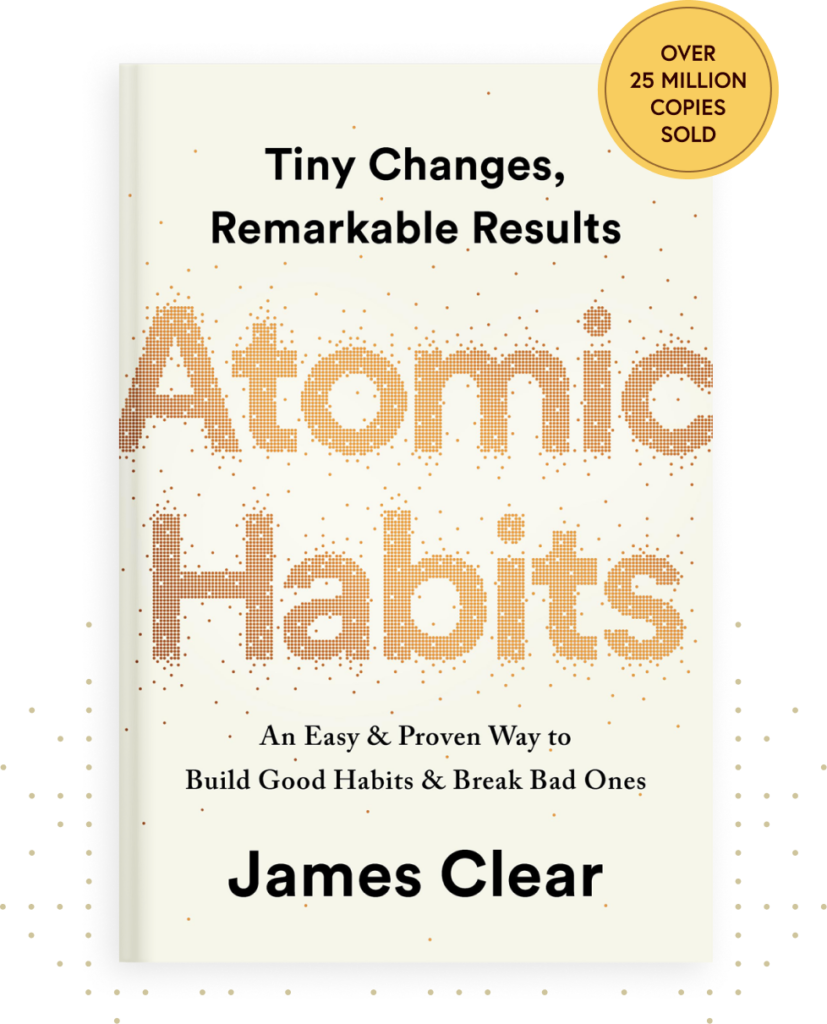
Atomic Habits is one of those books that manages to speak to the reader with disarming clarity, without ever descending into banality. James Clear builds his thesis on a simple but often overlooked insight: change does not arise from heroic gestures, but from consistently repeated micro-actions. It is the accumulation of small daily improvements that generate profound transformations, just as invisible and tiny atoms build solid and complex structures.
The book moves effortlessly between behavioral psychology, neuroscience, and real-life stories. It does so with a clear style, exposing its concepts and the truths that are most difficult to grasp. It also uses a style that fosters awareness of the reader’s own characteristics.
The most pleasant feeling while reading is the way it presents concepts with a warm calm, without ever scalding you with statements that can sometimes generate a slight sense of “realization” discomfort.
Clear, in addition to explaining how habits work, shows how they shape identity and, I might add, alter a person’s existence and choices, sometimes without even realizing it. His most powerful idea is that every repeated action is a vote in favor of the type of person we want to become. It’s a powerful concept if you think about it carefully. Personally, I’ve always perceived changing habits as a sacrifice, an effort to do something in order to achieve something. He changed my way of perceiving change and the effort to achieve it. Changing isn’t about going from reading zero to reading fifty books a year, but about becoming a person who reads, perhaps, a page every other day. And here I’m getting banal, but appetite comes with eating. This shift in perspective makes the process less fragile and much more sustainable, because it’s rooted in a sense of self that builds day by day.
The book’s strength also lies in its ability to make immediately applicable concepts that, in everyday life, risk—and often successfully—remaining abstract, demonstrating how the environment, the perception of effort, immediate gratification, and automatic repetition are fundamental levers for building or abandoning a habit. Each chapter connects naturally to the next, creating a coherent and organic path that guides the reader from theoretical understanding to daily practice, without ever losing the thread. It’s a rare thing to read with passion both for a style of writing and the story being told.
If you want to find a limit, perhaps some examples will be familiar to those who have read extensively on the topic of human behavior. I’m going to break a lance for Clear, and no offense to anyone, if I say that many mindset concepts are similar or even often the same old, rehashed, old stuff. I believe that skill in this art lies in providing the best examples, rather than in finding the most original idea. And in fact, the strength of Atomic Habits lies not in the absolute originality of the concepts, although that is also there, but rather in their presentation to the reader. Clear manages to construct a simple and elegant system that works precisely because it doesn’t claim to revolutionize the reader’s life, but rather to improve it, one small step at a time.
I found this an uplifting read, never boring, and a pleasant novelty, if only for the way the author recounts the dozens of episodes mentioned.
I wish you a good read and thank you for your precious time.
L.C.


Lascia un commento